BioNIR
Real-Time SpectroscopyWhat if you never had to send a sample to a lab again?
Scope on requestBioNIR uses visible and near-infrared (Vis-NIR) spectroscopy to read soil composition without wet chemistry. Today it runs as a fast, non-destructive lab analysis; it is also an active R&D programme building toward portable field scanners and embedded sensors. Scope and pricing are defined per project.
It is built for farms, agronomists and research partners who want frequent, low-cost soil readings at field resolution. Because BioNIR is still developing, the best way in is a scoping conversation about your soils, target parameters and the cadence you need.
Granularity when you need it. Adjust crop inputs at the resolution your fields demand — not at the resolution the lab can afford.
Three Phases to Autonomy
Lab-Based Vis-NIR
Send us your samples for a fast, non-destructive Vis-NIR read — much quicker than traditional wet chemistry, with the sample returned intact for further testing. Turnaround is confirmed when we scope your project.
Portable NIR Devices
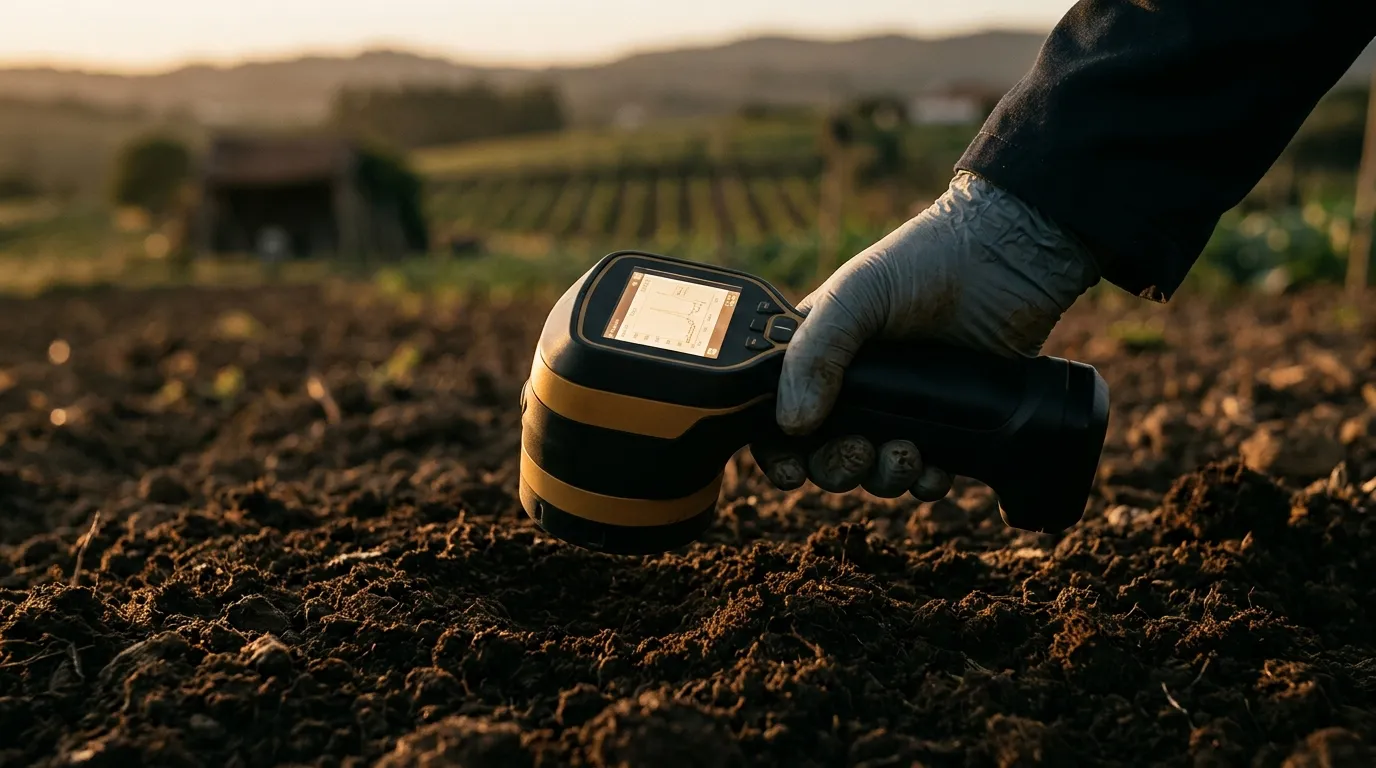
Handheld NIR scanners deployed in your fields. Point, scan, read. Minutes instead of days. Calibrated against our lab database for your specific soil types and crops.
Embedded Autonomous Sensors
NIR sensors embedded in irrigation lines and mounted on drone payloads. Continuous, autonomous monitoring. Real-time data flowing into SoilMind for instant adjustment recommendations. Your fields, self-aware.
Light Reveals What Chemistry Hides
Visible and near-infrared spectroscopy works by shining light through your soil sample and reading the absorption signature. Different compounds absorb different wavelengths. The spectrum is a fingerprint — unique, precise, and fast to read.
From Sampling to Sensing
The lab is a bottleneck. Sampling is a snapshot. What agriculture needs is continuous, real-time awareness of soil conditions — the way a thermostat knows temperature.
BioNIR is our path to that future. Embedded sensors in irrigation systems that monitor soil chemistry with every watering cycle. Drone-mounted NIR payloads that scan entire fields in a single flight. Data that flows directly into SoilMind, triggering precision adjustments to fertilisation, irrigation and crop protection.
Continuous field intelligence: soil conditions read in real time, feeding precise, automatic adjustments to irrigation, fertilisation and crop protection.
Frequently Asked Questions
How accurate is it compared to lab analysis?
For well-calibrated parameters, Vis-NIR spectroscopy can approach the agreement of traditional wet-chemistry analyses, with the advantage of fast, non-destructive results. Accuracy depends on the parameter, the soil type and the calibration behind it.
Does it work in all field conditions?
The method is being developed for real field conditions, including moisture and temperature variation. Calibration is required for each soil type.
When will it be commercially available?
BioNIR is under active development as an R&D programme. Contact us to learn about early access and testing partnerships.
Ready to start?
Send us your samples, share your research question, or tell us about your project — we'll design the right analytical protocol.
Request analysis